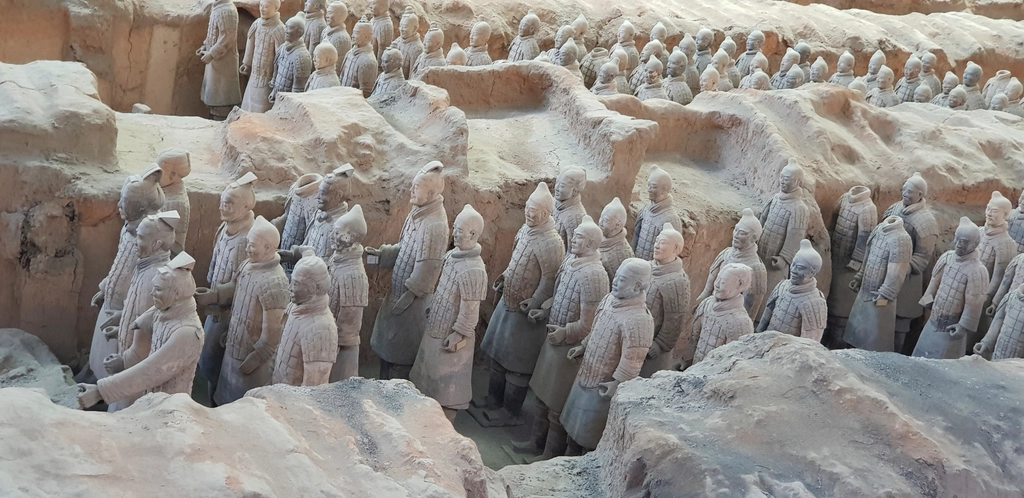
English Edition | C#55 秦始皇與徐福的尋仙之旅Have you ever wondered what it would be like to live past 100? The idea of living forever has fascinated people for centuries. Even though hitting 100 was rare in the past, today it’s becoming more common. As these numbers rise, so do our hopes—and the question of how we’d spend life’s later years. But the desire to live long and stay healthy isn’t just a modern obsession. Over 2,000 years ago in China, people were already seeking ways to extend life. Let me take you back to one of the most famous stories in this quest for immortality. Long ago, there was a powerful emperor in China—Qin Shi Huang. He unified six kingdoms and built a centralized empire. Despite having unmatched power, even he could not escape death. Obsessed with finding a way to live forever, he embarked on a legendary journey to discover immortality. The man at the heart of this story? Xu Fu. According to historical records, in the 28th year of Qin Shi Huang’s reign, Xu Fu—an expert in alchemy and the pursuit of immortality—told the emperor that magical immortals lived across the sea and possessed a potion that could grant eternal life. Xu Fu asked for permission to set sail with a group of boys and girls to find these immortals. Qin Shi Huang agreed. Xu Fu led thousands of children on this mysterious voyage. But years passed, and the elixir was never found. Several years later, Qin Shi Huang sent others skilled in alchemy and mystical arts to continue the search for immortality. Later, in an effort to control dissenting scholars, the emperor ordered the burning of books, yet he carefully preserved texts on medicine, divination, and even planting trees—all knowledge related to health and prolonging life. At one point, Xu Fu reported back that while it was possible to reach the immortals, enormous sea creatures blocked their path. He requested that Qin Shi Huang send archers to deal with these giant sea monsters. Following his advice, the emperor dispatched skilled archers along the coast. The next year, Qin Shi Huang passed away—still without the elixir of life. Xu Fu disappeared from historical records, leaving his fate a mystery. But legend has it that after the archers dealt with the sea creatures, Xu Fu set out once more. This time, he brought seeds, artisans, and tools, eventually arriving at a warm, beautiful land with friendly people. He settled there, taught the locals farming, fishing, and even paper-making—and never returned. Some say that the “immortal mountain” Xu Fu spoke of was what we now know as Japan. So, two thousand years ago, Qin Shi Huang’s relentless search for immortality seems not so different from today’s fascination with health and longevity. But here’s the question: what really drives our quest for a longer life, and how much has changed over the centuries? I’ll dive into that in the next episode. Stay tuned for the next issue! Phrase of the Week長生不老 (cháng shēng bù lǎo)Meaning: To live forever; immortality Sample Sentences: 1. 秦始皇一生都在追求長生不老。
2. 沒有人真的能長生不老。
3. 古代的皇帝相信仙藥可以讓人長生不老。
4. 現代人追求健康,而不是長生不老。
|