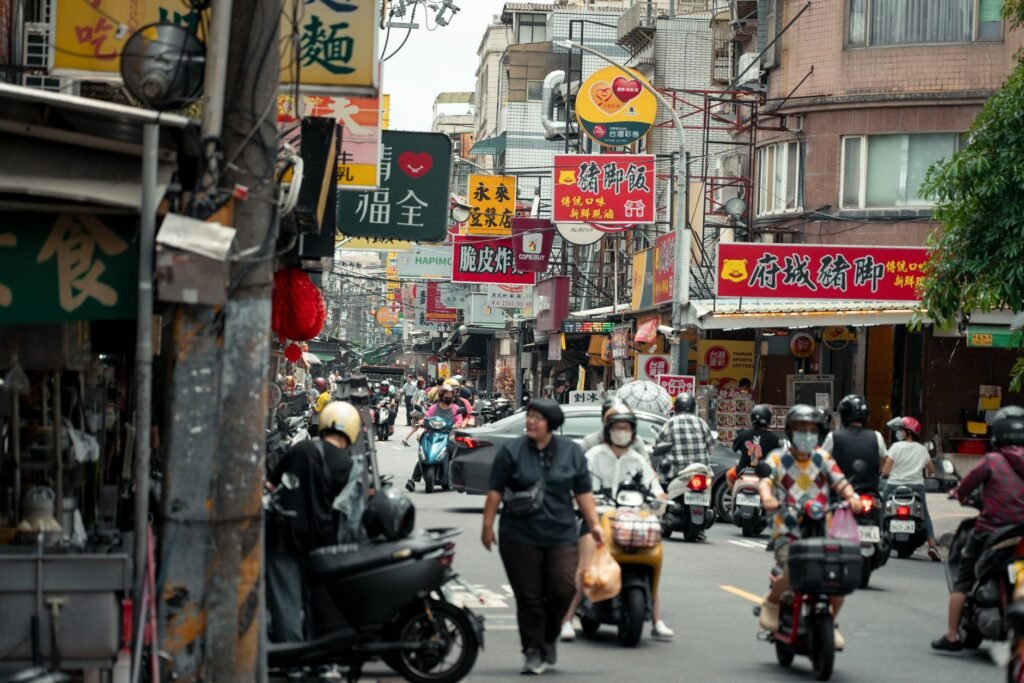
If you really want to understand Taiwanese daily life, I recommend you start with a traditional market, instead of a museum or a shopping mall. I grew up going to markets with my family. Even now, with convenience stores on every corner a convenience store open 24 hours a day, traditional markets are still deeply rooted in our daily rhythm. They are where locals buy vegetables, fresh meat, handmade dumplings, fruit, and breakfast. They are noisy, friendly, and full of stories. A market is not just a place to shop; it is a living space where human connections quietly continue, generation after generation. In Taiwan, life moves fast. Many people work long hours, order food online, and barely know their neighbors. But in a traditional market, time seems to slow down. Vendors remember your face, ask about your family, and tell you which vegetables are sweetest today. That sense of familiarity is something no app can replace. What You Can Find in a Typical Market A typical Taiwanese market usually wakes up before sunrise. By the time most people are still asleep, vendors are already setting up their stalls, arranging vegetables, sharpening knives, and preparing fresh food. You’ll find piles of leafy greens still wet with water, tofu freshly made that morning, fish laid neatly on ice, and pork cut to order. Fruit stalls are bright and colorful—bananas, papayas, pineapples, and seasonal fruits stacked like small mountains. Some stalls sell handmade dumplings or spring rolls, others sell dried mushrooms, spices, or traditional snacks. One of my favorite parts of the market is breakfast. You can grab warm soy milk, rice balls, scallion pancakes, or steamed buns, all while walking through narrow aisles. For many locals, the market is where the day truly begins. But beyond food, what you really find is conversation. Short chats, laughter, complaints about the weather, and advice about cooking. These small interactions create a sense of belonging that feels very Taiwanese. The Untold Rules You Learn in the Market Traditional markets also have many unspoken rules—things no one teaches you, but everyone somehow knows. First, eye contact matters. When you look at a vendor and ask politely, you’re showing respect. Even if you don’t buy anything, a simple “不好意思” (sorry) goes a long way. Second, bargaining exists, but it’s subtle. You don’t aggressively push for lower prices like in some tourist markets. Instead, regular customers may get a little extra—an extra chili, a slightly bigger apple—without even asking. Relationships matter more than numbers. Third, timing is important. Go too early, and vendors are busy setting up. Go too late, and many items are sold out. Regulars know the best time for vegetables, meat, or discounts near closing time. Lastly, patience is a must. Markets are crowded, noisy, and sometimes chaotic. You wait your turn, move slowly, and accept that this is part of the experience. It teaches you to slow down and be present. Conclusion In Taiwan, traditional markets continue to exist not because they are convenient, but because they are meaningful. They connect us to our food, our culture, and each other. They remind us that daily life is not just about efficiency, but about relationships and shared experiences. For me, visiting a market feels like coming home—a place where familiarity, warmth, and humanity quietly survive in a fast-changing world. If you want to understand Taiwan, don’t just look at our skyline. Walk through a market, listen to the voices, and feel the rhythm of everyday life. Phrase of the Week人情味 (rén qíng wèi)Meaning: Human warmth; the kindness and warmth between people Examples:
– Zhè ge shìchǎng zuì xīyǐn rén de dìfāng jiùshì tā nóngnóng de rénqíngwèi. – The most attractive part of this market is its strong sense of human warmth.
– Lǎobǎn jìdé wǒ de xǐhào, ràng wǒ gǎnshòu dào mǎn mǎn de rénqíngwèi. – The vendor remembers my preferences, making me feel real human warmth.
– Suīrán chéngshì hěn mánglù, dàn shìchǎng lǐ réngrán chōngmǎn rénqíngwèi. – Although the city is busy, markets are still full of human warmth.
– Rénqíngwèi shì chuántǒng shìchǎng zuì zhēnguì de jiàzhí. – Human warmth is the most precious value of traditional markets. |