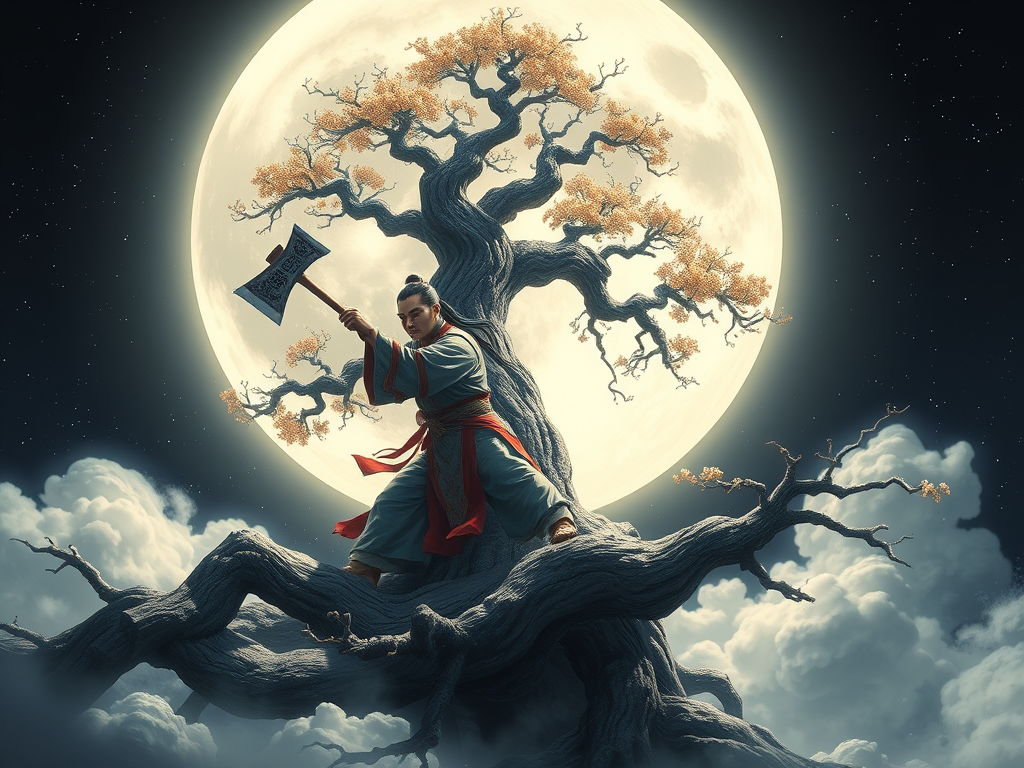
English Edition | C#62 如果有一天,吳剛不再揮動斧頭 | 《吳剛伐桂》During Mid-Autumn Festival in Taiwan, it’s very common for us to sit with mooncakes in hand and look up at the moon. When we were kids, adults would tell us a story: On the moon, there is an osmanthus tree, and a man endlessly chopping it down. His name is Wu Gang. Growing up, I still sometimes find myself looking at the moon. But one day, a different thought came to me: What if one day, Wu Gang stopped swinging his axe? What would happen then? The story we all heardThe version we grew up with goes like this: Wu Gang was punished because of his impatience and desire for shortcuts. He was sent to the moon palace and tasked with chopping down an osmanthus tree that can never be felled. Every time he swings his axe, he leaves a mark on the trunk. But the moment he lifts the axe again, the wound heals instantly—returning the tree to its original state. So he keeps repeating the same motion. Day after day. Year after year. When I was young, I thought this was simply punishment. But now, I can’t help wondering if there is another interpretation. What if he simply stopped?Imagine one day Wu Gang gets tired—not physically, but mentally. Not exhausted in his arms, but in his heart. And he stops. He puts down his axe and sits beneath that osmanthus tree. For the first time, he hears his own breathing. He feels the silence of the moon palace. In that silence, he is no longer “doing” anything. He just observes: The texture of the tree bark. The way the wind moves through the leaves. The rhythm of existence itself. And maybe then, he notices something important: The tree is not being defeated by him—it is constantly restoring itself. This is not an ordinary tree. It is a tree that always returns to its original state. A reflection of our own livesThis image reminds me of modern life in Taiwan. We are constantly busy. People rush to work in the morning, handle endless responsibilities after work. Some prepare for exams, some chase promotions, some learn investing or languages—trying to become better versions of themselves. On the surface, it looks like we are working hard. But sometimes I wonder: Are these actions truly changing anything? Or are we, like Wu Gang, endlessly chopping a tree that keeps healing itself? We change jobs, hoping life will improve. But after a while, we find ourselves back in the same pressure. We learn more skills, but still feel anxious or unsettled. Sometimes, the more we try, the more exhausted we become. Maybe the problem isn’t effort. Maybe it’s direction. Just like Wu Gang—he keeps swinging his axe without realizing the truth of the tree. And we often keep running without understanding what we are really running toward. When “trying harder” isn’t enoughIn Taiwan, I’ve often been encouraged by teachers and people around me: “Keep going.” “Try harder.” These words are not wrong. But without direction, effort can slowly turn into self-consumption. That’s why I’ve started to believe something different: Stopping is not giving up. Sometimes, stopping is simply creating space to begin again with clarity. If Wu Gang ever put down his axe, maybe that moment is when he finally starts to truly live. The power of pausingMaybe he would realize: The osmanthus tree was never meant to test him. It was meant to invite him to pause. As long as his mind remains restless, the tree will always return to its original form. But once his heart becomes still, something changes. And perhaps that is also true for us. Some problems are not solved by doing more. Some answers only appear when we become quiet enough to see them. A different kind of “success”So I often remind myself: I don’t always need to rush forward. Sometimes, it’s more important to stop, to observe, and to think. Because real change doesn’t always come from more action. It comes from clearer understanding. ClosingLet’s return to that image again. The moon still hangs quietly in the sky. The osmanthus tree is still there. And in my imagination, Wu Gang is no longer swinging his axe. He simply sits beneath the tree, looking at the moonlight. And maybe, finally, he understands: True freedom is not endless effort—it is knowing when to stop. Do you ever feel the same way? Phrase of the Week回到原點 (huí dào yuándiǎn)Meaning: To return to the starting point; to end up where you began. Sample Sentences:
|