
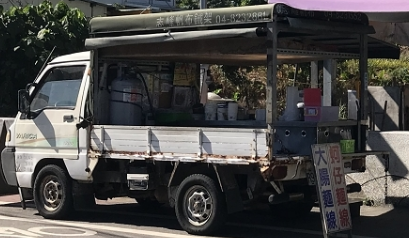
If you’ve grown up in Taiwan, you’ve probably heard the familiar sounds of prosperity truck (發財車 fācái chē)—those mobile vendor trucks that roll down the street, blasting their announcements: “Repair glass! Screens and doors!” or “Oyster vermicelli! Taiwanese meatballs! Stinky tofu!”
Maybe, just like me, you’ve had that instant reaction—rush downstairs, grab some food, or call the repairman. But these calls aren’t just about selling things. They’re part of a larger social network that connects people, goods, and culture. And when you look at it from a sociological perspective, there’s a lot more going on behind that cheerful, sometimes piercing, voice.
A Bit of History
To really understand 發財車 (fācái chē), we need to go back in time a bit. Taiwan used to have fewer people, and transportation wasn’t as convenient as it is today. Not every village had shops nearby, and markets weren’t as common. This created a problem: how do you sell goods to people who live far away? Enter the 發財車 (fācái chē). Small business owners loaded up trucks with whatever they sold—snacks, fruits, vegetables, or even tools—and drove from village to village. To let people know they were there, they used loudspeakers and calls.
Some trucks sold food—oyster vermicelli, stinky tofu, meatballs—while others offered services like repairing doors, windows, or screens. For residents, these trucks weren’t just convenient, they were a part of daily life. People would see a 發財車 (fācái chē) approaching, recognize the call, and immediately know what was available. It was a kind of social interaction, even before people interacted directly: neighbors would share news, kids would run downstairs, and community life subtly revolved around these mobile vendors.
The Mobile Economy
So, what exactly is a mobile economy? In simple terms, it’s businesses that move to the customer instead of waiting for customers to come to them. 發財車 (fācái chē) are a perfect example. Their loud calls tell residents exactly what’s available at that moment—fresh snacks, household repairs, or everyday necessities. Compared to a fixed shop, they offer flexibility, speed, and convenience.
Think about it: your window screen breaks? A 發財車 (fācái chē) might be passing by and can fix it the same day. Feeling hungry? The vendor’s call could lead you straight to your favorite snack. This was especially important for older residents, people living alone, or anyone who couldn’t travel far. Today, of course, technology has changed things. Online shopping, delivery apps, and e-commerce platforms have taken over much of what 發財車 (fācái chē) used to do. But even in our digital age, the charm of the trucks—and the cultural significance of their calls—remains strong.
The Sociological Significance of Calls
Here’s where it gets really interesting. The calls themselves are more than just advertisements—they’re social signals. When a 發財車 (fācái chē) drives by and announces its products, people respond. Children might run downstairs. Neighbors might pause and chat. Someone remembers, “Oh! I needed that repair today.” In this way, the call isn’t just selling—it’s connecting people and shaping social interactions.
The calls also carry local flavor. Depending on the area, you might hear different accents, dialects, or ways of speaking. This familiarity creates a sense of belonging. For older generations, hearing a familiar call might bring back childhood memories. For younger people, it’s a small but important part of local culture. For Taiwanese living abroad, hearing these calls can evoke a strong sense of nostalgia—it’s a sound of home.
The Triple Network: People, Goods, and Culture
We can think of 發財車 (fācái chē) as forming three interconnected networks:
- People: The vendor connects with regular customers, neighbors share news, and the community interacts naturally. These trucks don’t just sell products—they strengthen social ties.
- Goods: The trucks deliver items and services directly to residents, making daily life easier and more convenient. This circulation of goods also helps the local economy flow more smoothly.
- Culture: The calls themselves carry local identity, dialects, and traditions. They preserve not just products or services, but also memories, habits, and a sense of place. For someone living overseas, hearing a 發財車 (fācái chē) call can be like stepping back in time to Taiwan.
These three networks—people, goods, culture—reinforce each other. Together, they show why a simple mobile truck can be such a rich cultural and social phenomenon.
Modern Changes and Cultural Value
Of course, times have changed. Technology, online shopping, and delivery apps have made life easier in many ways. Some people today might find 發財車 (fācái chē) calls noisy or intrusive. But for others, they are nostalgic and comforting, a reminder of community life and simpler times. Even though the trucks are no longer essential for commerce, they remain cultural symbols. They remind us that business is not only about transactions—it’s also about human connection and shared memory. These calls help preserve a sense of community, identity, and local culture, something we don’t want to lose.
Conclusion
So next time a 發財車 (fācái chē) drives by your street, pause for a second. Listen. Behind that cheerful, sometimes piercing call is a network of people, goods, and culture. It’s not just about buying a snack or getting a repair—it’s about community, memory, and connection. That little truck on the street is carrying a piece of Taiwan’s living history.
And maybe—just maybe—it’s worth running downstairs, if only to taste a bit of your(or our) childhood.
Latest Episode
In this week’s episode, **C#45 你聽過這些街頭叫賣聲嗎?一車的台灣味 (Nǐ tīng guò zhèxiē jiētóu jiàomài shēng ma?), I dive into the nostalgic and lively world of Taiwanese “發財車” (fācái chē, mobile vendor trucks). I share my own memories of hearing their iconic calls for oysters, stinky tofu, and repair services while walking the streets or standing on my balcony. These trucks are more than just moving businesses—they’re a vibrant part of Taiwan’s local culture and personal memories.
I also include two classic call recordings, so you can guess what’s being sold and feel the excitement of this mobile marketplace. Whether you find them noisy or comforting, these sounds carry stories of convenience, community, and shared experiences. Tune in, and maybe you’ll be reminded of a 發財車**(fācái chē)** that passed by your street when you were growing up!
Phrase of the Week
人情味 (rén qíng wèi): Human warmth; friendliness and compassion.
Sample Sentences:
- 發財車的叫賣聲充滿人情味,讓社區更溫暖。
Fācáichē de jiàomài shēng chōngmǎn rén qíng wèi, ràng shèqū gèng wēnnuǎn.
The mobile vendor’s calls are full of human warmth, making the community warmer.
- 雖然只是簡單的一碗麵線,老闆的招呼裡卻充滿了人情味。
Suīrán zhǐ shì jiǎndān de yī wǎn miànxiàn, lǎobǎn de zhāohū lǐ què chōngmǎn le rén qíng wèi.
Even if it’s just a simple bowl of vermicelli, the vendor’s greetings are full of human warmth.
- 老街的小吃攤散發著人情味。
Lǎo jiē de xiǎochī tān sànfā zhe rén qíng wèi.
The old street food stalls exude human warmth.
- 在這個冷漠的都市裡,發財車的叫賣聲讓街坊感受到人情味。
Zài zhège lěngmò de dūshì lǐ, fācáichē de jiàomài shēng ràng jiēfāng gǎnshòu dào rén qíng wèi.
In this indifferent city, the calls of the mobile vendors make the neighborhood feel human warmth.