
Sometimes, learning a new language feels awkward—especially when you already understand the meaning behind an idea, but the way it’s expressed in another language is completely different.
It’s not just about learning new words or grammar rules; it’s about adjusting your habits of expression. You might know exactly what you want to say, but expressing it in a different structure or order can feel uncomfortable and unnatural at first.
Recently, I taught my students how to use the Chinese grammar pattern “等…才” (děng… cái), which means “not until.” In this structure, one action must happen first, and only then will the second action follow. The two parts are closely linked in sequence and logic. For example, in English we say, “I won’t go out until he comes back.” In Mandarin, the sentence would be: “等他回來,我才會出門” (Děng tā huílái, wǒ cái huì chūmén), which directly translates to “Wait for him to come back, only then I will go out.” This structure emphasizes that the first event (him coming back) must happen before the second (going out) can occur.
What makes it even more challenging is how the sentence structure is reversed in Chinese compared to English. In English, the focus is usually placed on the second action, the one that is delayed — “I won’t go out…” — and then the condition is added — “…until he comes back.” But in Chinese, the sentence starts with the condition — “等他回來” (děng tā huílái) — and then follows with the result — “我才會出門” (wǒ cái huì chūmén). For English speakers learning Mandarin, this reversed order can feel strange. Their brains are used to placing the main action first, so switching to a structure that starts with the condition requires a mental reset.
This reversal in expression often leads to awkwardness because it forces learners to unlearn their natural way of thinking. It’s not that the grammar is difficult — it’s the shift in perspective that’s hard. The good news is, with consistent practice and exposure, this awkwardness can be overcome. The key is to stop translating directly from English and start thinking in Chinese. Focus on building your sentence with the Chinese logic: condition first, then result. The more you immerse yourself in authentic language use — by reading, listening, and speaking — the more natural this structure will begin to feel.
When it comes to language learning, translating directly may help you quickly understand the meaning, but it won’t help you make the language second nature in the long run. Once you move past the beginner level, one of the most powerful things you can do is to stop translating from your native language. While translation can be useful at the start, relying on it for too long becomes a barrier. Languages aren’t just different sets of words—they reflect different ways of thinking. For example, Chinese often emphasizes context and conditions before results, while English tends to highlight the outcome first. When you stop translating and begin forming thoughts directly in the language you’re learning, you naturally start to absorb grammar patterns, sentence flow, and cultural logic. This shift increases your fluency, reduces hesitation, and helps you speak and write with more confidence.
As I shared the tricky grammar point ‘等…才 (děng… cái),’ you might still feel a bit confused about how to use it. No worries—below is a full explanation with sample sentences to help you understand how it works.
Phrase of the Week
等…才 (děng… cái)
Meaning: Not until… (The second action happens only after the first one is completed.)
Use this structure when one action must happen first before the second can occur.
This grammar reflects the Chinese way of prioritizing context and conditions before results — a logical sequence that’s commonly seen in daily life planning, scheduling, and even interpersonal relationships.
- Structure: 等 + [first event],才 + [second event]
- Function: Express sequence and condition clearly.
Sample Sentences:
- 等我吃完飯,我才會去運動。
Děng wǒ chī wán fàn, wǒ cái huì qù yùndòng.
Wait until I finish eating, then I’ll go exercise.
- 等老師來了,我們才開始上課。
Děng lǎoshī lái le, wǒmen cái kāishǐ shàngkè.
We won’t start class until the teacher arrives.
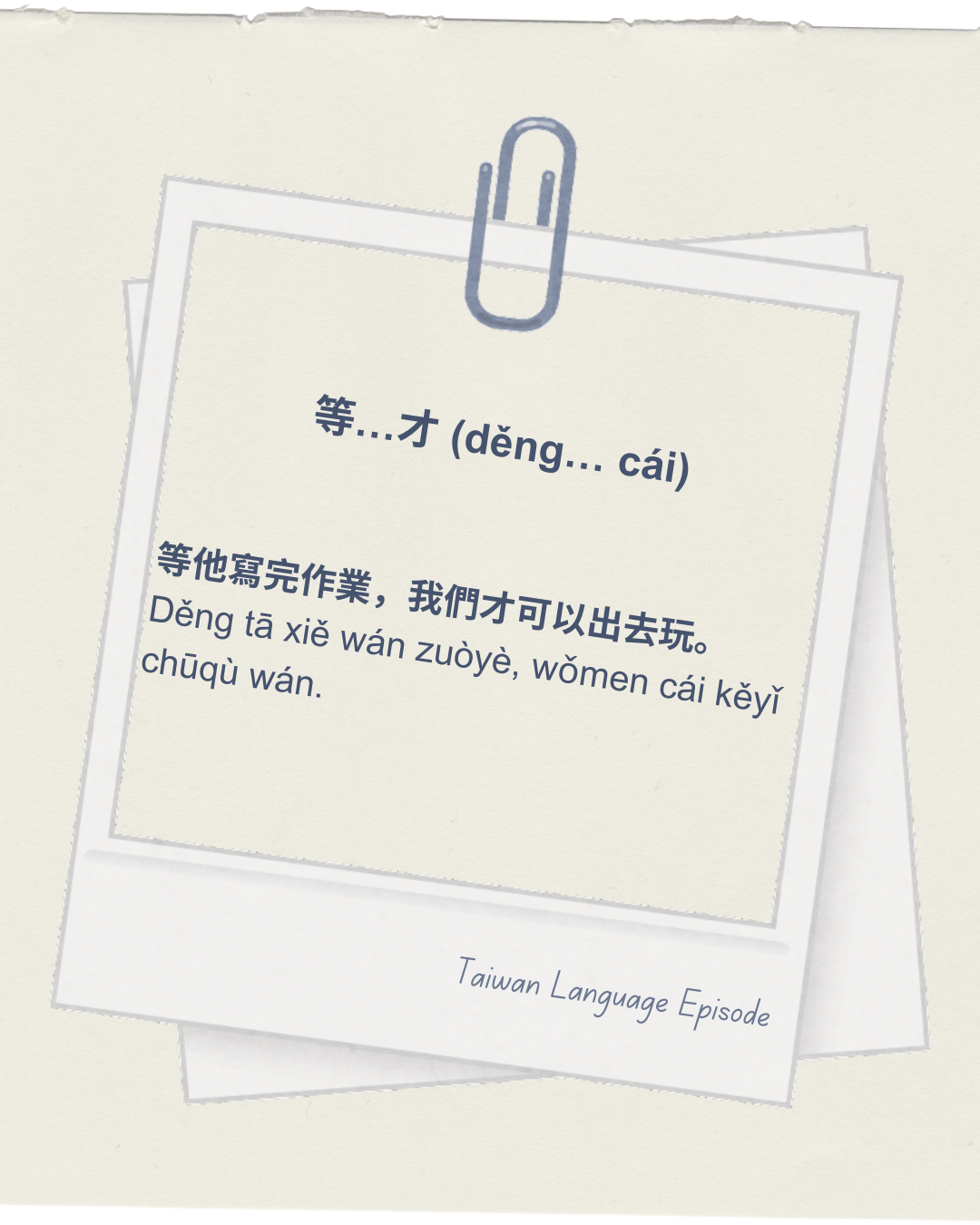
- 等他寫完作業,我們才可以出去玩。
Děng tā xiě wán zuòyè, wǒmen cái kěyǐ chūqù wán.
We can’t go out to play until he finishes his homework.
- 等雨停了,我才會離開。
Děng yǔ tíng le, wǒ cái huì líkāi.
I’ll leave only after the rain stops.
- 等你準備好了,我們才會出發。
Děng nǐ zhǔnbèi hǎo le, wǒmen cái huì chūfā.
We’ll leave only when you’re ready.